Litter Dust and Air Purifiers
Can an air purifier help with litter dust?
Understand what particle filters can do, size the airflow for your room and keep odor expectations realistic.
Quick Answer
Reduce dust at the box first, then size a particle filter for the air space it will actually serve. A purifier’s particle CADR helps compare airflow; it does not tell you how well that unit removes litter odor, and a headline room-size claim may assume a speed you would not use.
Before You Buy Anything
- Check pouring, scooping and floor-cleaning habits that stir up dust.
- Measure the connected air space, including ceiling height.
- Compare particle CADR at a usable speed and check replacement-filter cost.
Diagram
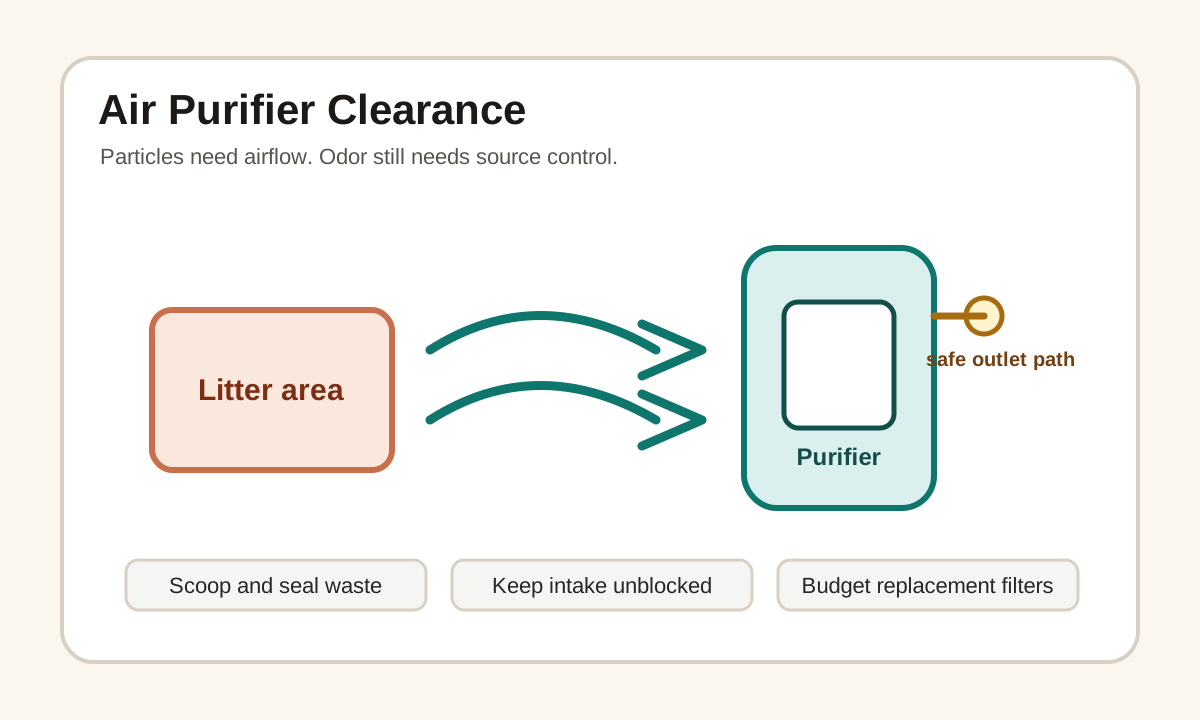
A closer look at the setup. This illustration is a planning aid; follow your model’s instructions for assembly.
Common Causes
- Pouring from a height and vigorous handling can release particles.
- Dust on floors can be stirred back into the air.
- An undersized unit or low fan setting may move less air than the room needs.
- Particle removal and gas or odor removal are different tasks.
Step-by-Step Fix
- Handle litter gently and clean settled dust using methods suitable for the surfaces.
- Measure length, width and ceiling height of the space; an open doorway may connect more air than one room’s floor plan suggests.
- Choose an air-changes-per-hour planning assumption and use the sizing tool to calculate equivalent airflow.
- Compare that result with the unit’s published particle CADR, noting which speed the rating uses.
- Plan a position with manufacturer-required intake and outlet clearance, a safe cord route and convenient filter access.
Make the airflow arithmetic visible
For feet, multiply length × width × ceiling height to get cubic feet. Multiply by your chosen air changes per hour, then divide by 60 to get cubic feet per minute (CFM). A 10 × 12 × 8 ft room at 4 air changes per hour gives 64 CFM.
That is an idealized planning target, not a measured reduction in your apartment. Doors, airflow patterns, placement and fan speed all affect the result. The tool also accepts meters and converts the same room volume to an equivalent target.
Dust and odor need different questions
Particle CADR is useful for comparing particle-cleaning capacity. It does not rate gas removal. An odor claim needs separate evidence about the sorbent material, its amount, conditions of use and replacement needs.
If the room smells of litter, remove waste and check the box area first. Keep expectations modest: adding a purifier adds its own filter, cleaning and storage costs.
What Not to Buy Yet
- An ozone-generating air cleaner for an occupied home.
- A particle filter sold as a cure for every odor.
- A unit that only meets your target at a speed you will routinely turn down.
Maintenance Schedule
- Follow the purifier’s cleaning and filter-replacement instructions.
- Keep intake and outlet clear of furniture and accumulated dust.
- Recalculate if the unit moves to a different or more open space.
When This Is Not a Gear Problem
Small Space Cat Gear does not provide veterinary advice. Contact a veterinarian promptly if your cat shows urinary changes, straining, blood in urine, unusual thirst, appetite changes, vomiting, lethargy, distress, sudden litter box avoidance, or other concerning symptoms.
Keep going
Sources and Official References
- AHAM Verifide air filtration standards
Official CADR sizing reference, including the two-thirds room-area rule and high-ceiling caveat.
- US EPA - Guide to Air Cleaners in the Home
Official reference for source control, CADR particle sizing, HEPA particle filtration, activated carbon limits for gases, filter replacement, and ozone cautions.
- US EPA - Ozone Generators that are Sold as Air Cleaners
Official reference for avoiding ozone-generator claims and for not treating EPA registration or references as air-cleaner endorsement.
- California Air Resources Board - air cleaner information for consumers
Official reference for ozone and electrical-safety checks; CARB certification is not a test of pollutant-removal effectiveness.
- California Air Resources Board - certified air cleaning devices
Official certified-device list for checking ozone-related certification without treating certification as pollutant-removal performance proof.
- AAFP/ISFM Environmental Needs Guidelines
Reference for food, water, litter, resting, and multi-cat resource separation.
- AVMA - Feline lower urinary tract disease
Used for routing urinary warning signs to veterinary care.